


Beyond Blueprints: The Tech Rewiring Modern Construction

The era of the "2D drawing" construction site is fading fast. As we look at the industry standards in 2026, the buildings currently taking shape are undergoing a radical transformation. They aren’t just being "built", they are being engineered, simulated, and optimized long before a single brick touches the ground.
If you are planning a commercial development or a premium residential estate, the question should no longer be "how fast can you build?" but rather: "how are you using data to reduce project risk?"

1. The Digital Twin: BIM as the Project "Brain"
Building Information Modeling (BIM) is now the foundational requirement for durable construction. Think of it as a "digital twin" of your project. Before breaking ground, we construct the entire facility in a 3D virtual environment that encompasses not just walls, but structural reinforcement, mechanical systems, electrical routing, and thermal efficiency data.
The ROI of Precision: BIM allows for "clash detection," identifying potential conflicts between structural beams and utility lines before materials are even ordered. This eliminates the expensive, time-consuming on-site reworks that typically inflate the final construction cost.
2. Factory-Grade Modular Precision
There is a new strategy towards hybrid/modular techniques. In creating high precision structural elements in controlled and climate regulated settings, we ensure a certain quality standard that simple masonry work can never achieve.
It is not just a matter of efficiency but also of uniformity. In producing our structural columns or custom-made facade panels under factory standards, you get a stronger end product which will work regardless of external conditions.
3. Predictive Climate-Resilient Engineering
Modern engineering is much more than just 3D engineering. It is about 4D (adding time), 5D (adding cost), and even 6D (integrating sustainability). Through our environment simulation software we achieve the following goals:
1. Optimizing natural ventilation by placing buildings according to wind patterns in order to ensure passive cooling.
Implementing smart materials by predicting the areas that need advanced waterproofing/anti-corrosion treatments in order to offer a long-term protection for the building structure.
Utilizing high-performance glazing by incorporating units capable of letting maximum light while rejecting sun radiation.

4. Precision Monitoring: Drones and IoT
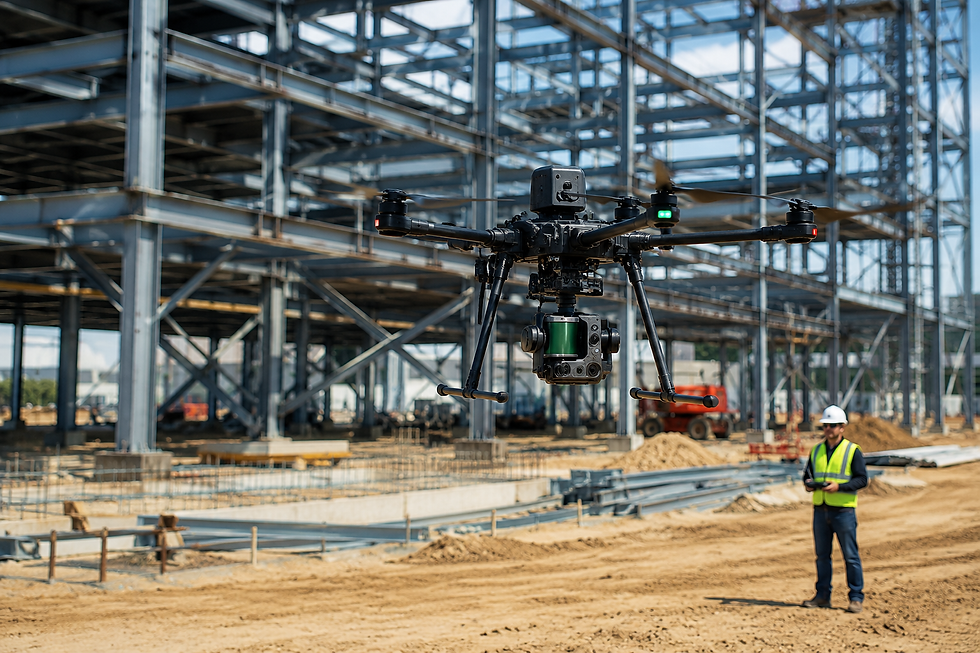
There is no room for guessing in a contemporary build. Our team makes use of drones with LiDAR scanning technology to assess the progress made by comparing them to BIM models. This allows for every footing, column, and floor to be poured precisely to the millimeter.
This level of structural engineering service creates a transparent project loop. You no longer have to wonder if your project is on track—the live data confirms it.
Conclusion: Investing in a Data-Driven Asset
A building today is more than just concrete and steel, it is an information-rich asset. By adopting these high-tech building technologies, you aren't just getting a structure; you are getting a highly engineered machine designed for performance, longevity, and sustainability.
Whether you are developing a commercial hub or a legacy private estate, your project deserves the precision that 2026 technology provides.
Are you ready to build with data, or are you still relying on traditional guesswork?


Comments